
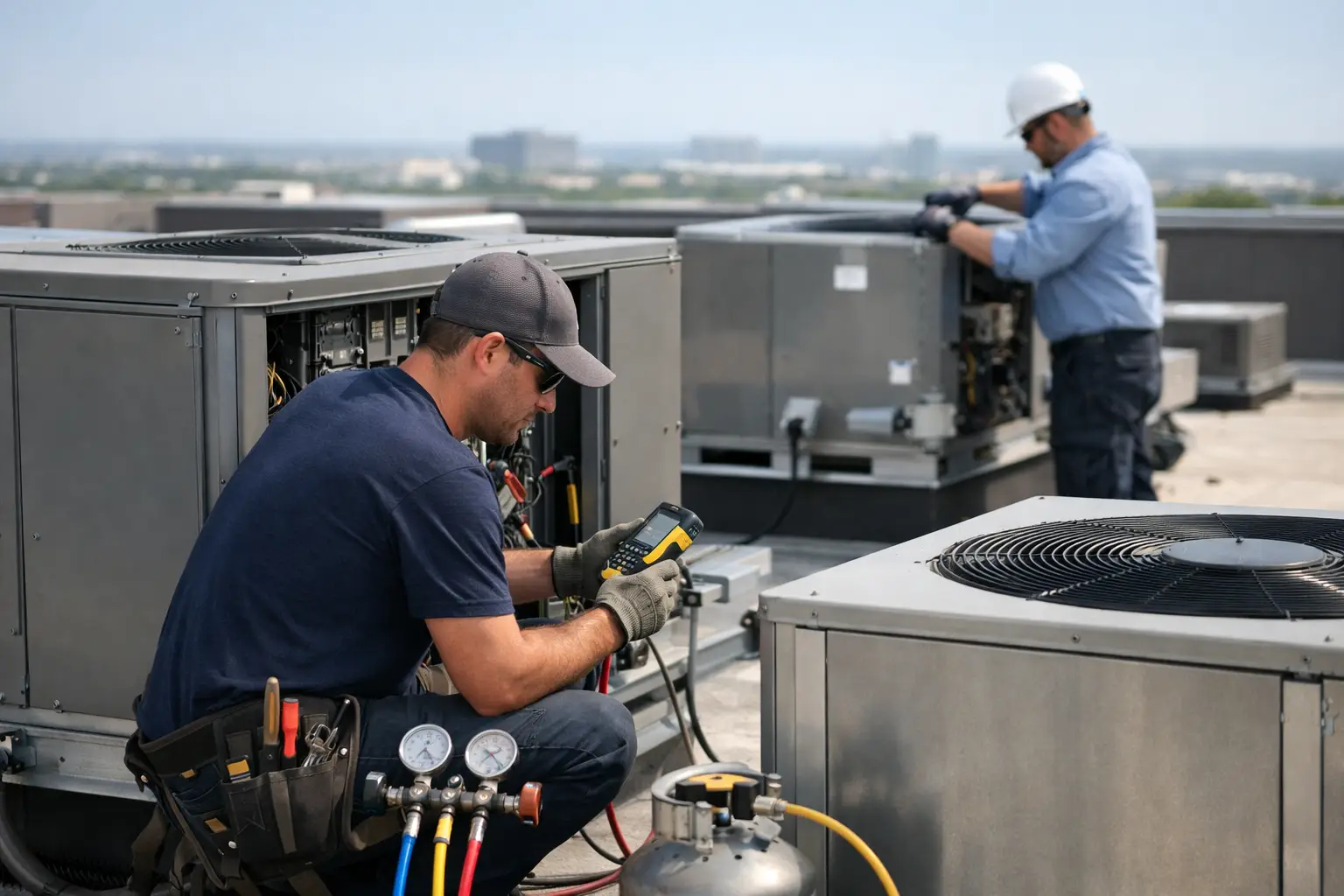
A rooftop unit can look fine from the parking lot and still be one hot afternoon away from a service interruption. For businesses across Magnolia, The Woodlands, and greater Houston, knowing how to prepare commercial rooftop units before heavy cooling demand arrives can protect tenant comfort, employee productivity, inventory, and your operating budget.
Commercial RTUs work hard in Texas. Extended heat, humidity, windblown debris, sudden storms, and long run times can expose small issues quickly. Preparation is not just changing filters and hoping for the best. It is a planned inspection of the equipment, controls, electrical components, drainage, and the roof environment around the unit.
Start With Safety and a Clear Service Plan
Rooftop HVAC work requires more than a ladder and a quick visual check. Roof access, electrical disconnects, moving fan assemblies, refrigerant circuits, and wet roof surfaces all create legitimate safety risks. Facility staff can handle basic observations and housekeeping, but qualified commercial HVAC technicians should perform electrical testing, refrigerant diagnostics, internal cleaning, and repairs.
Before anyone goes to the roof, document which units serve each area of the building. Record unit model numbers, serial numbers, filter sizes, thermostat or building-control zones, and any recurring comfort complaints. A tenant reporting that a conference room gets warm every afternoon gives a technician a useful starting point. It may point to an undersized system, a thermostat issue, poor airflow, solar load, or an RTU beginning to lose capacity.
Schedule preparation before peak demand when possible. Waiting until the first 100-degree stretch means technicians, replacement parts, and rental cooling options may all be harder to secure. For many commercial properties, spring maintenance and a late-summer performance check offer the best protection.
How to Prepare Commercial Rooftop Units Step by Step
A complete RTU preparation visit should focus on performance, reliability, and the conditions that can cause equipment to fail early. The exact scope depends on the unit’s age, operating hours, building use, and maintenance history, but the following areas deserve attention.
Clear the unit and roof perimeter
Leaves, plastic bags, insulation fragments, nesting material, and cottonwood can collect around condenser coils and outside-air openings. These obstructions restrict airflow and force the system to work harder to reject heat. That can raise energy use, reduce cooling capacity, and increase compressor strain.
Technicians should also confirm that the unit is level and that the curb, panels, fasteners, and access doors are secure. Loose panels allow water and debris into the cabinet. Damaged cabinet insulation can affect efficiency and indoor air quality. On the roof itself, keep service access clear and coordinate with roofing professionals if there are signs of ponding water, deteriorated flashing, or penetration leaks near the curb.
Replace filters and inspect airflow
Dirty filters are one of the most preventable causes of commercial comfort complaints. A clogged filter reduces airflow across the evaporator coil, which can cause coil icing, weak cooling, higher static pressure, and unnecessary wear on blower components.
Use the correct filter size and efficiency rating for the system and the building’s needs. Higher-efficiency filtration can improve particle capture, but it can also increase resistance if the unit was not designed for it. This is one reason filter selection should be based on manufacturer requirements and measured airflow, not just the highest rating available.
During service, the technician should inspect blower belts, pulleys, bearings, motors, dampers, and evaporator coils. Worn belts can slip and reduce airflow. A dirty evaporator coil may look minor but can significantly affect cooling and dehumidification during a humid Houston-area summer.
Clean condenser coils and verify fan operation
The outdoor condenser section releases heat pulled from the building. When condenser coils are coated with dirt or debris, the unit cannot shed heat efficiently. Head pressure rises, cooling output drops, and electrical components work under greater stress.
Coil cleaning should be done carefully with methods appropriate for the coil and surrounding equipment. Bent fins may need to be straightened, and condenser fans should be checked for proper rotation, vibration, damaged blades, and motor condition. A loud fan, repeated cycling, or noticeable vibration is not normal operating noise to ignore. It is a reason to investigate before the problem becomes a shutdown.
Check electrical components before they fail
High temperatures put added stress on capacitors, contactors, wiring connections, relays, and disconnects. A commercial technician can inspect these components for wear, overheating, corrosion, pitting, and loose connections. They can also test voltage, amperage, capacitors, and compressor operation against expected ranges.
Electrical issues are often intermittent at first. A unit may cool normally in the morning, then fail during the hottest part of the day when demand is highest. Catching a weak capacitor or damaged contactor during planned maintenance is typically less disruptive than responding to an emergency no-cooling call during business hours.
Inspect refrigerant performance and drainage
Low cooling capacity does not automatically mean a unit needs refrigerant. Refrigerant levels should be evaluated through proper diagnostic testing, not guesswork. If a technician identifies a leak, the right approach is to locate the cause, discuss repair options, and verify system performance after the repair.
Condensate drainage also needs close attention. In humid conditions, commercial units produce a substantial amount of water. Clogged drain lines, damaged pans, or improperly draining traps can lead to water damage, microbial growth, ceiling stains, and shutoffs that take the unit offline. The drain assembly should be cleaned, tested, and inspected for leaks.
Test thermostats, economizers, and controls
A well-maintained RTU still cannot perform correctly if its controls are sending the wrong commands. Verify thermostat accuracy, schedules, fan settings, occupied and unoccupied modes, and communication with any building automation system.
Economizers require particular attention. When conditions are suitable, they use outside air to assist with cooling. When dampers stick open during hot, humid weather, however, they can bring in excessive heat and moisture. A technician should confirm damper movement, sensor readings, and control sequences rather than assuming the economizer is helping.
Build a Maintenance Schedule Around Your Building
There is no single service interval that fits every commercial property. A small office with limited occupancy may need a different plan than a restaurant, warehouse, medical office, retail center, or property with multiple tenants. Equipment that runs long hours, handles high ventilation loads, or operates near trees and construction activity usually needs more frequent attention.
For most properties, filters and basic equipment condition should be reviewed regularly, while comprehensive preventive maintenance should be scheduled at least twice each year. Businesses with critical cooling needs may benefit from quarterly visits, priority service, detailed records, and a plan for rapid response if a unit fails.
Keep a simple log of service dates, repairs, filter changes, temperature complaints, and energy-use changes. Rising utility costs, uneven temperatures, frequent breaker trips, water around ceiling diffusers, short cycling, and unusual noise are early warning signs. They do not always mean replacement is necessary, but they should not be treated as routine.
Know When Repair Is No Longer the Best Option
Preparation also means making practical decisions about aging equipment. If an RTU requires repeated major repairs, uses outdated refrigerant, struggles to maintain comfort, or has become expensive to operate, replacement may offer better long-term value. The right choice depends on repair cost, remaining equipment life, efficiency gains, warranty coverage, and the consequences of downtime for your business.
A transparent estimate should explain the condition of the current unit, the repair options available, and what a replacement would improve. For some businesses, a targeted repair and continued maintenance is the responsible choice. For others, a high-efficiency replacement can reduce operating costs and prevent recurring disruptions during the busiest season.
A commercial rooftop unit rarely fails at a convenient time. Give your facility team a clear plan, address small warning signs early, and have a licensed HVAC partner ready before the next heat wave puts every system on the roof to the test.