
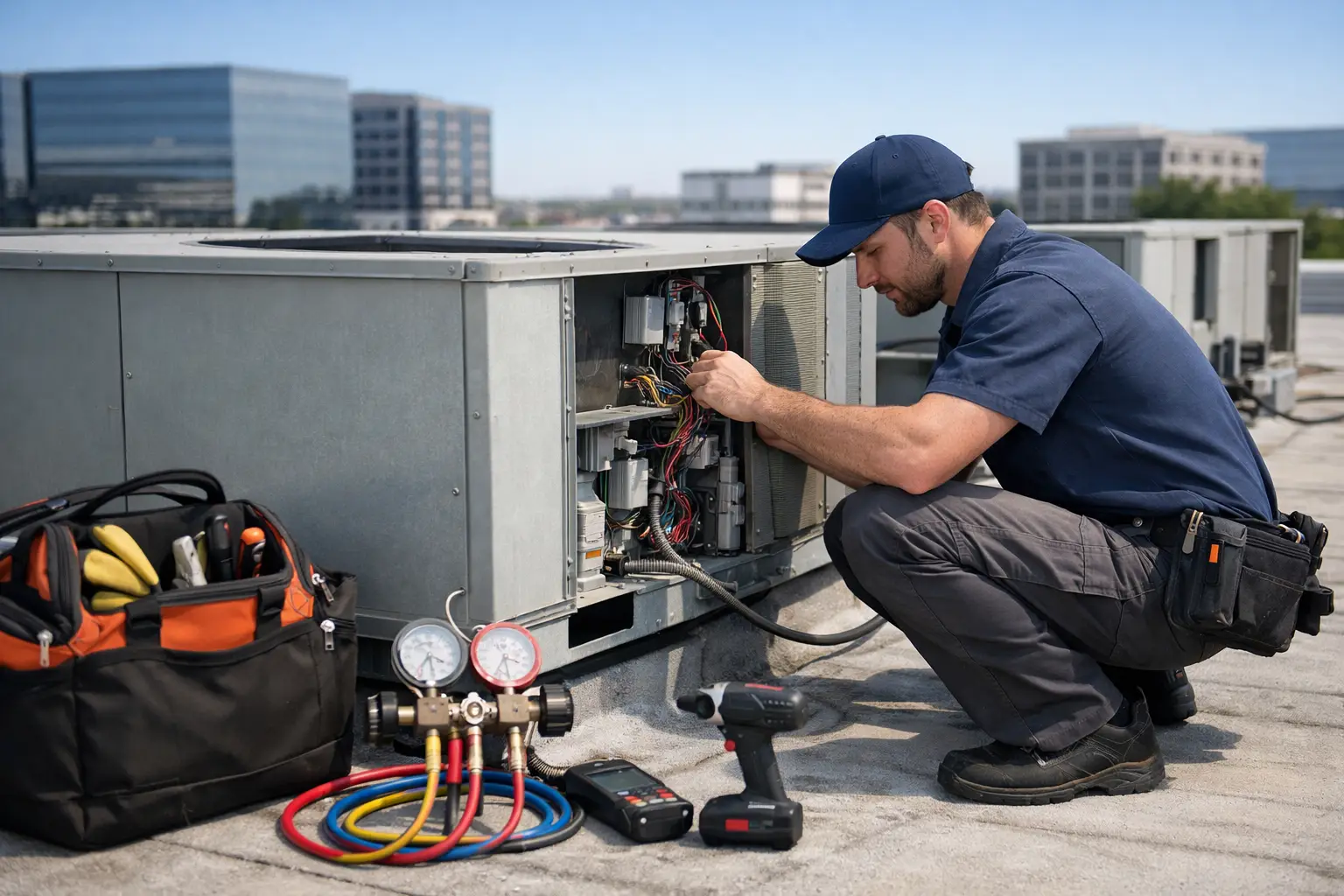
A rooftop unit rarely fails at a convenient time. It starts with hot spots in the office, complaints from tenants or staff, or a store that suddenly feels humid and uncomfortable during peak hours. Rooftop unit repair for businesses is not just about getting cool air moving again. It is about protecting operations, avoiding lost revenue, and fixing the actual cause before a minor issue turns into a system shutdown.
For business owners and property managers, the biggest mistake is treating an RTU problem like a simple nuisance. In commercial spaces, HVAC performance affects employee productivity, customer experience, inventory protection, and even equipment reliability. A quick reset might buy you a few hours, but it does not solve worn electrical components, airflow restrictions, refrigerant issues, or failing controls.
Why rooftop unit repair for businesses needs a fast response
Commercial HVAC problems tend to compound quickly. One weak component can force the rest of the system to work harder, which raises operating costs while lowering comfort. If a blower motor is dragging, a capacitor is failing, or a condenser coil is packed with debris, the unit may still run, but it will do so inefficiently and under strain.
That matters even more in Texas heat. In places like Magnolia, The Woodlands, Spring, Tomball, Conroe, and Houston, rooftop systems often operate under heavy demand for long stretches. When an RTU is already carrying a serious cooling load, even a small repair delay can turn into an emergency call.
Fast service also matters because commercial schedules are less forgiving than residential ones. Restaurants, retail stores, offices, warehouses, churches, and multi-tenant properties all have different occupancy patterns, but none of them benefit from comfort complaints or mid-day system interruptions. The sooner the issue is diagnosed correctly, the more options you usually have.
Common RTU problems that show up in commercial buildings
Most rooftop unit issues do not begin with a total breakdown. They show up as uneven temperatures, longer run times, higher utility bills, or equipment that short cycles during occupied hours. Those symptoms can point to several different repair needs.
Electrical failures are one of the most common categories. Contactors, capacitors, relays, wiring connections, and control boards all wear over time. A unit may power on inconsistently, fail to start a compressor, or trip safeties that shut the system down. These problems can look random from the ground, but they usually leave a clear trail during a proper diagnostic visit.
Airflow problems are another frequent cause. Dirty filters, clogged evaporator coils, damaged belts, failing blower motors, and blocked duct paths can all reduce airflow. When airflow drops, comfort drops with it. The unit may freeze up, struggle to dehumidify, or push conditioned air unevenly through the building.
Refrigerant-related issues are more nuanced than many business owners expect. Low refrigerant is not a maintenance setting that just needs topping off. If refrigerant is low, there is usually a leak or another underlying fault. Simply adding charge without finding the source is a short-term move that often leads to repeat problems.
Economizer and control issues also come up often in commercial settings. A faulty damper, bad sensor, or control sequence problem can cause the unit to bring in too much outside air, not enough outside air, or fail to switch modes correctly. That affects comfort, ventilation, and efficiency all at once.
Signs your business should schedule repair now
Some warning signs are obvious, but others are easier to dismiss until they become expensive. If your rooftop unit is making unusual noises, producing weak airflow, cycling on and off too often, or struggling to maintain set temperature, it is time to have it checked.
A sudden jump in energy use is another strong indicator. Businesses often notice the utility bill before they notice the mechanical issue. When an RTU begins losing efficiency, it can keep the space barely comfortable while quietly driving up operating costs.
Water around the unit or signs of indoor moisture matter too. Drainage issues, frozen coils, and poor dehumidification can lead to water damage or indoor air quality concerns if left alone. For retail and office environments, that can quickly become more than an HVAC issue.
If one zone is uncomfortable while another feels fine, the problem may not be the thermostat alone. It could involve dampers, controls, airflow balancing, or a unit that cannot keep up anymore. That is where a thorough commercial HVAC diagnosis matters more than a quick guess.
Repair or replace? It depends on more than age
Business owners often ask the right question at the wrong time. They ask whether they should replace the unit only after repeated repairs have already disrupted operations. The better question is whether the current repair will restore reliable performance at a reasonable cost.
Age matters, but not by itself. A well-maintained rooftop unit can often justify repair even after years of service, especially if the issue is isolated and the rest of the equipment is in solid shape. On the other hand, a newer unit with recurring electrical, compressor, or control problems may deserve a harder look if downtime is becoming a pattern.
Repair usually makes sense when the problem is clearly defined, parts are available, and the unit still meets the building’s demand. Replacement becomes more attractive when repair costs keep stacking up, efficiency is poor, refrigerant issues are recurring, or the system is undersized for the space.
There is also an operational side to the decision. For some businesses, even one major outage costs more than the repair invoice. Lost productivity, uncomfortable customers, or tenant frustration can shift the math quickly. That is why transparent recommendations matter. A contractor should be able to explain what failed, what the repair solves, and what risks still remain.
What a proper commercial rooftop repair visit should include
A real rooftop unit repair call should start with diagnostics, not assumptions. Commercial systems are too complex and too important for guesswork. The technician should verify the complaint, inspect electrical components, check motors and moving parts, evaluate refrigerant performance, review controls, and test system operation under load.
That process matters because symptoms overlap. Poor cooling could be caused by low airflow, a weak capacitor, a failing compressor, a dirty coil, a thermostat issue, or a control sequence problem. Replacing the wrong part wastes time and keeps the real issue in place.
Good repair service also means clear communication. Business owners and facility managers need to know what failed, how urgent the repair is, whether a temporary workaround exists, and what to expect next. That kind of clarity helps with budgeting and scheduling, especially if the repair needs to happen outside business hours.
At BluePeak 360, that practical approach is what commercial clients expect. They want licensed and insured service, transparent pricing, and a repair plan that protects the business instead of creating more uncertainty.
Preventing repeat rooftop unit repairs
The cheapest repair is usually the one you never need. Preventive maintenance is what keeps many rooftop units out of emergency mode, especially during the hottest part of the year. Regular service helps catch worn belts, dirty coils, weak capacitors, drainage problems, loose electrical connections, and airflow restrictions before they trigger a breakdown.
For businesses, maintenance is less about checking a box and more about reducing avoidable surprises. A neglected unit might still run, but it often runs harder, costs more, and fails sooner. That is especially true for properties with long operating hours or buildings where comfort complaints escalate quickly.
It also helps to pay attention to filter schedules, thermostat settings, and changes in occupancy or layout. A building that has added equipment, shifted floor plans, or changed business hours may be asking more from the rooftop unit than it did a year ago. Sometimes the repair issue is real, but the bigger problem is that the system is no longer matched to the load.
When you treat rooftop HVAC as part of business continuity instead of a background utility, repair decisions get easier. You catch issues earlier, plan upgrades more intelligently, and reduce the odds of dealing with an emergency on the worst possible day.
If your building is showing signs of uneven cooling, rising energy costs, weak airflow, or repeated shutdowns, do not wait for a full outage to force the issue. The right repair at the right time can buy back comfort, efficiency, and peace of mind before the problem spreads across the rest of the system.