
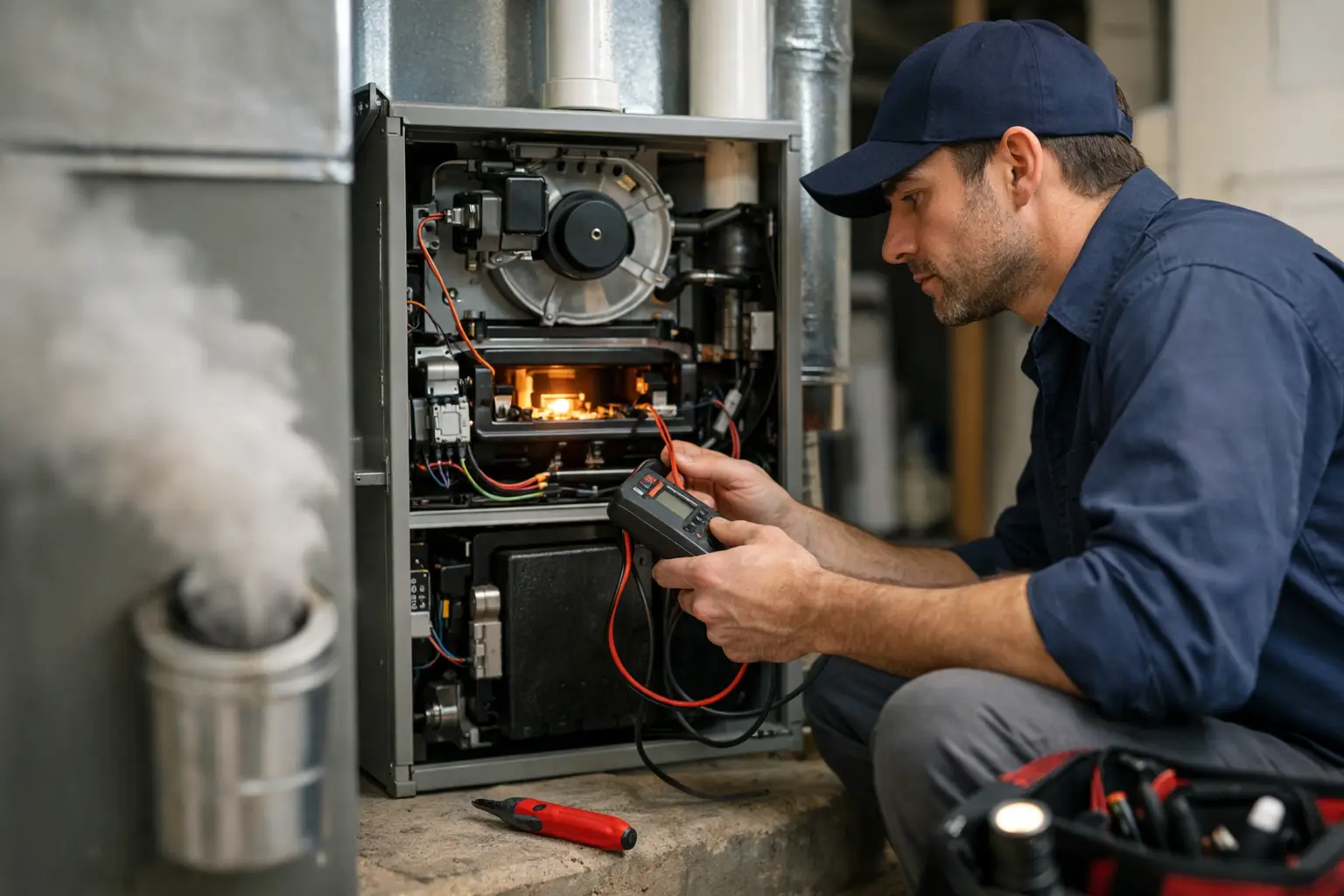
Your furnace has been sitting quiet since about March. On the Gulf Coast it rests for eight months, then the first cold snap asks it to fire up like nothing happened. Most years, it does. But a gas furnace that has not run in months can develop problems you cannot see, and the most dangerous one has no smell and no color: carbon monoxide.
Every fall, before heating season starts, this is the check that matters most. Not comfort. Safety. BluePeak 360 runs heating inspections across Magnolia, The Woodlands, Spring, Tomball, Conroe, Montgomery, Shenandoah, and Oak Ridge North. Call (832) 823-1148 or book your visit online.
Why a Gas Furnace Makes Carbon Monoxide
When natural gas burns the way it should, it produces carbon dioxide and water vapor. When something is off, a cracked heat exchanger, a blocked flue, a burner problem, combustion goes incomplete and produces carbon monoxide instead. Your furnace is built to send those gases outside through the flue. The danger starts when they do not get there.
A fall heating tune-up exists largely for this reason: to catch the cracked exchanger, the rusted flue, and the lazy burner before the first cold night.
Warning Signs on the Equipment
You cannot detect carbon monoxide itself. What you can spot are the furnace problems that produce it:
- Burner flame color. A healthy gas flame burns mostly blue. A flame that is mostly yellow, flickering, or looks lazy instead of sharp is a sign of incomplete combustion. Worth a call on its own.
- Soot or rust. Black soot marks around the furnace cabinet, on the flue pipe, or near vents. Rust on the flue or vent connector means moisture where it should not be, and corrosion weakens the parts that carry exhaust outside.
- Unusual condensation. Excess moisture on windows near the furnace area can point to venting trouble.
- The furnace acting strange. Shutting itself off, short cycling, a pilot light that will not stay lit. Safety controls shut a furnace down for a reason. Do not keep resetting it.
- New smells. Carbon monoxide has no smell, but other combustion problems do. Treat any new odor around the furnace as a reason to call, not a reason to wait.
Warning Signs in Your Body
Headaches, dizziness, nausea, confusion, or flu-like symptoms with no fever. The pattern that matters: more than one person in the house feels it, and it eases up when you leave. Pets acting unusually lethargic can be a sign too. Do not try to diagnose this yourself. Treat it as an emergency.
What to Do If You Suspect Carbon Monoxide
- Get everyone out of the house immediately, including pets.
- Call 911 from outside. Do not go back in to open windows or grab things.
- Do not run the furnace again until a licensed technician has inspected it and cleared it.
This is not a “wait until morning” situation. Fire departments respond to CO alarms for a reason.
How to Keep It From Happening
- Get the fall inspection. Once a year, before heating season, a tech checks the heat exchanger, flue, burners, and safety controls. That is the core of our heating maintenance visit, and it is the single best prevention there is.
- Put CO alarms where they belong. One on every floor, one outside each sleeping area, following the alarm manufacturer’s instructions. Test them monthly. Most alarms need replacement every 5 to 7 years, check the date printed on the back. An old alarm that never sounds might just be dead.
- Never heat with the wrong equipment. Not the oven, not a stove, not a portable generator indoors. Generators belong outside, well away from windows and doors.
- Keep the furnace area clear. Do not block supply or return vents, and keep storage away from the furnace so it gets the airflow and clearance it was installed with.
- Take a cracked heat exchanger seriously. If we find one, we shut the furnace down on the spot and show you. That furnace does not run again until the exchanger is replaced or the unit is. No exceptions. More on the repair warning signs here.
The Honest Part
A tune-up lowers the risk. It does not make a 20-year-old furnace new. If your system is old and has a history of repairs, the safest move may be replacement, and we will tell you that straight. What we will not do is find a cracked heat exchanger, patch around it, and call it good. Some things are not negotiable.
FAQ
Can you smell carbon monoxide?
No. It is colorless and odorless. Only a working CO alarm detects it, which is why alarm placement and fresh alarms matter more than your nose.
Where should CO alarms go?
On every level of the home and outside each sleeping area, per the alarm manufacturer’s instructions. Bedrooms on an upper floor need coverage too, not just the floor with the furnace.
How long do CO alarms last?
Most need replacement every 5 to 7 years. Check the manufacture date printed on the back of the unit and replace the whole alarm, not just the battery.
Does a fall tune-up check for carbon monoxide?
We inspect the parts that cause it: heat exchanger, flue, burners, and safety controls, and we test for CO where it makes sense. The tune-up plus working alarms is the combination that protects a home.
My furnace is old but runs fine. Should I worry?
Age alone is not the danger; condition is. An inspection tells you which one you have. If everything checks out, you heat the winter with confidence. If it does not, you find out in October instead of on the coldest night of the year.
Heating season is about to start. Make sure yours starts safe. Call BluePeak 360 at (832) 823-1148 for a fall heating safety inspection in Magnolia, TX, or book your visit online.