
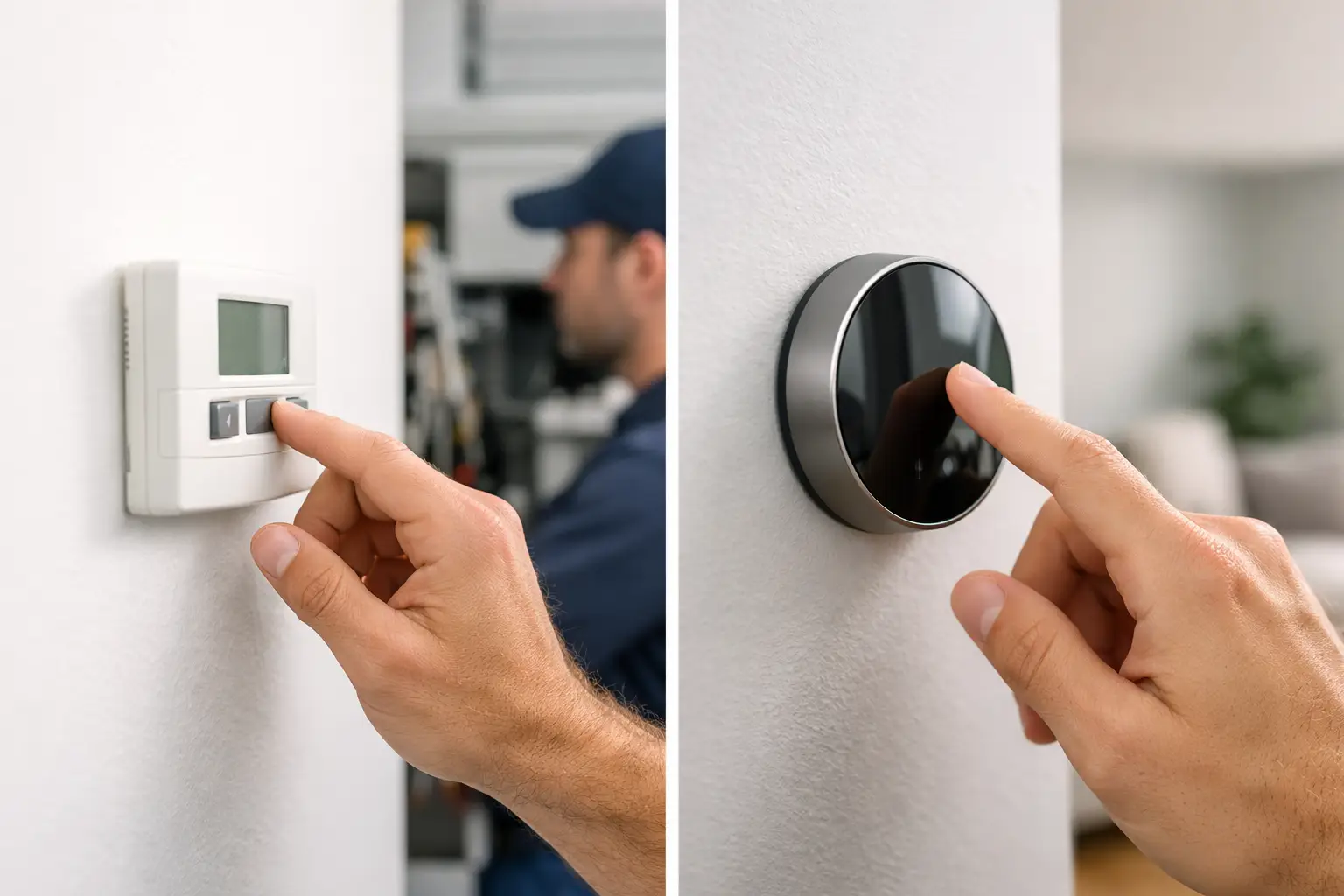
If your thermostat still has one setting for morning, afternoon, and midnight, you are probably paying for comfort you do not need. When homeowners compare programmable thermostat vs smart thermostat options, the real question is not which one is newer. It is which one fits your schedule, your HVAC system, and how hands-on you want to be.
A better thermostat can help manage energy use, reduce temperature swings, and make your home more comfortable during long Texas cooling seasons. But the right choice depends on your habits. Some people want a simple schedule they can set and forget. Others want phone control, automation, and system data they can check from anywhere.
Programmable thermostat vs smart thermostat: the basic difference
A programmable thermostat follows a schedule that you create. You tell it when to raise or lower the temperature based on the time of day and, on many models, the day of the week. Once it is set properly, it runs that schedule until you change it.
A smart thermostat does more. It usually includes app control, remote access, alerts, and more advanced automation. Some models can learn patterns, use occupancy data, track energy use, and integrate with other smart home devices. In simple terms, every smart thermostat can handle scheduling, but not every programmable thermostat can handle smart features.
That sounds like an easy win for smart thermostats, but it is not always that simple. More features do not automatically mean better results. If those features go unused, the added cost may not deliver much value.
When a programmable thermostat makes more sense
A programmable thermostat is often the better fit for households with a steady routine. If everyone leaves for work and school at about the same time, comes home on a predictable schedule, and prefers a consistent indoor temperature, a basic programmable unit can do the job well.
It also appeals to people who do not want another app to manage. Once the schedule is in place, there is very little to think about. That simplicity can be a real advantage, especially for rental properties, small offices, or homes where ease of use matters more than extra technology.
Cost is another factor. Programmable thermostats generally have a lower upfront price than smart models. If your goal is to replace an old manual thermostat without spending much, this can be a practical upgrade.
The trade-off is flexibility. If your day changes often, a fixed schedule can start working against you. Maybe someone stays home unexpectedly, maybe you leave town early, or maybe your work hours shift from week to week. In those situations, a programmable thermostat only saves energy if someone remembers to adjust it.
When a smart thermostat is worth the upgrade
A smart thermostat is usually the better choice for homes and businesses with changing schedules. If no two weekdays look the same, remote access becomes useful fast. You can adjust settings from your phone, change temperatures before you arrive, or reduce cooling when plans change.
That convenience matters in the Houston-area climate, where air conditioning is not a minor expense. If you forget to raise the temperature before leaving for the day, a smart thermostat lets you fix it without driving back home or letting the system run harder than necessary for hours.
Smart thermostats can also provide maintenance and performance benefits. Some models send filter reminders, system alerts, or notices when the HVAC system is running longer than expected. That does not replace professional diagnostics, but it can help you catch issues earlier.
For property managers and business owners, remote visibility can be especially useful. If a tenant reports comfort issues or a small office is cooling after hours, a smart thermostat can give quick insight into what is happening before a service call is made.
Energy savings: what actually makes a difference
Many buyers assume a smart thermostat always saves more money. Sometimes it does. But the biggest factor is not the thermostat itself. It is whether the settings match the way the building is actually used.
A programmable thermostat can save energy if the schedule is set correctly and followed consistently. A smart thermostat can save energy if its features are used to respond to real occupancy patterns, setbacks, and system behavior. The technology helps, but behavior still matters.
For example, if a homeowner installs a smart thermostat and leaves it on one constant setting all summer, savings may be limited. On the other hand, a programmable thermostat with a well-built weekday and weekend schedule can perform very well in the right home.
Smart models often have an edge when life is unpredictable. Their value shows up when settings are adjusted often, when remote access prevents wasted runtime, or when occupancy-based controls reduce unnecessary heating or cooling.
Installation is not always plug and play
This is where many thermostat decisions get more technical than expected. Not every HVAC system is compatible with every thermostat. Some smart thermostats require a C-wire for constant power. Some older systems, multi-stage systems, heat pumps, zoned systems, and commercial setups need careful compatibility checks before installation.
Even a programmable thermostat should be matched correctly to the equipment. If the thermostat is not configured properly, you can end up with poor temperature control, short cycling, or features that do not work as intended.
That is why installation matters. A thermostat may look simple on the wall, but it is the control center for your entire heating and cooling system. If you are already investing in better control and efficiency, it makes sense to have it installed and set up correctly.
Comfort and control in real-world use
Comfort is not just about the number on the display. It is also about how steady the home feels, how easy the controls are to use, and how well the thermostat fits your daily routine.
Programmable thermostats work best for people who prefer straightforward controls. There are fewer menus, fewer features, and fewer chances for user error. That can be a benefit for households that want simple operation.
Smart thermostats offer more control, but they also ask more from the user during setup. You may need to connect Wi-Fi, download an app, set preferences, and adjust automation settings. For some people, that is no problem. For others, it becomes one more device to troubleshoot.
A good HVAC contractor can help bridge that gap by setting the thermostat up properly from the start and explaining how to use it without overcomplicating things.
Which thermostat is better for older homes or commercial spaces?
Older homes can go either way. If the HVAC system is newer but the home itself has an inconsistent schedule, a smart thermostat may still be a strong option. But if the wiring is limited or the equipment is older, compatibility should be checked before choosing a model.
Commercial spaces are similar. A small office with regular hours may do perfectly well with a programmable thermostat. A business with varying occupancy, after-hours operations, or multiple users may benefit more from a smart thermostat with remote access and better monitoring.
For both homes and businesses, the thermostat should support the equipment and the way the space is used. The best choice on paper is not always the best choice on the wall.
How to choose between a programmable and smart thermostat
If you want the short answer, choose a programmable thermostat if your schedule is predictable, your budget is tighter, and you prefer simple controls. Choose a smart thermostat if your schedule changes often, you want remote access, or you like having more insight into your system.
If you are also replacing HVAC equipment, that is a good time to review thermostat options. A new high-efficiency system should have controls that help it perform the way it was designed to. Pairing advanced equipment with outdated controls can limit the benefits.
For homeowners in Magnolia, The Woodlands, Spring, Tomball, Conroe, Houston, and surrounding areas, cooling demand is high enough that thermostat choice can make a noticeable difference over time. BluePeak 360 often sees the best results when the thermostat selection is based on actual usage patterns, not just the newest feature set.
A thermostat should make comfort easier, not more complicated. If you choose the one that fits your building, your schedule, and your HVAC system, it will do its job quietly in the background, right where it belongs.