
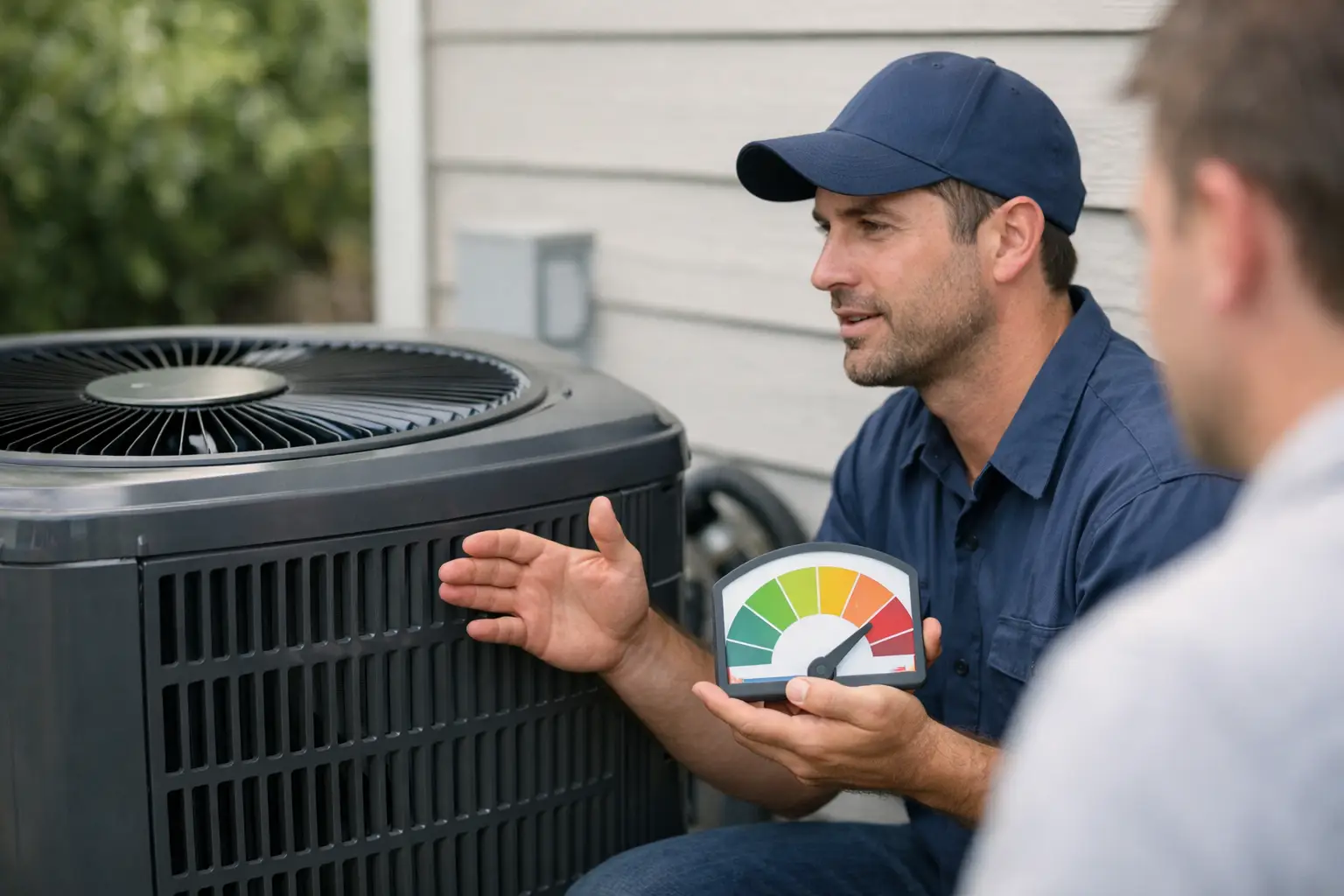
If you are shopping for a new AC or heat pump and the numbers on the equipment label feel more confusing than helpful, you are not alone. A lot of homeowners and property managers are now seeing new ratings on HVAC equipment, and one of the biggest questions is this: what is the seer2 efficiency rating explained in plain English, and how does it affect your monthly costs?
The short answer is that SEER2 is a newer way to measure cooling efficiency. It helps you compare one system to another under updated testing standards that better reflect real-world conditions. But that does not mean the highest number is always the best choice for every home or commercial space.
What SEER2 efficiency rating explained really means
SEER stands for Seasonal Energy Efficiency Ratio. SEER2 is the updated version of that rating. It measures how efficiently an air conditioner or heat pump cools over an entire season instead of at just one operating point.
A higher SEER2 number generally means the system uses less electricity to produce the same amount of cooling. For example, a 16 SEER2 unit is typically more efficient than a 14.3 SEER2 unit. That can translate into lower utility bills, especially in hot regions where cooling systems run hard for much of the year.
The key difference is that SEER2 uses a more demanding test procedure than the old SEER system. Manufacturers now test equipment with updated external static pressure requirements, which better account for real airflow resistance in ductwork and system components. In practical terms, SEER2 gives buyers a more realistic picture of how equipment may perform after installation.
Why the HVAC industry changed from SEER to SEER2
This change was not just a rebranding exercise. The goal was to improve how efficiency is measured so the published ratings line up more closely with actual field conditions.
Older SEER ratings were based on a testing method that did not reflect system resistance as accurately as it could. Since real HVAC systems deal with duct pressure, filters, coils, and airflow restrictions, the newer standard gives a tougher and more practical benchmark.
That matters when you are making a large investment. Whether you are replacing a residential split system in Magnolia or reviewing rooftop unit options for a commercial property in the Houston area, efficiency numbers should mean something useful. SEER2 is meant to make those comparisons more honest.
SEER vs SEER2: what changed for buyers
One of the most common points of confusion is that SEER2 numbers often look lower than older SEER numbers for similar equipment. That does not automatically mean the newer unit is less efficient.
It usually means the equipment is being measured under a stricter standard.
As a rough example, an older 16 SEER system may land around 15.2 SEER2, depending on the equipment type and configuration. The exact conversion is not one-to-one, and it is not smart to compare them casually without looking at manufacturer data. The important point is that SEER and SEER2 are not interchangeable labels.
If you are replacing an older system, it helps to compare your options using only SEER2 ratings, not mixed standards. That gives you a cleaner side-by-side view of current equipment.
Minimum SEER2 ratings in Texas
Texas falls under the Southeast region for federal energy efficiency standards. That matters because minimum requirements vary by region and by equipment type.
For many residential central air systems, the minimum efficiency standard in this region is higher than in northern states because cooling demand is heavier. In a climate where AC systems work through long, hot summers, minimum efficiency standards are designed with that load in mind.
Still, meeting the minimum is not the same as choosing the best long-term value. A basic compliant system may cost less upfront, but a higher-efficiency option may reduce operating costs enough to make sense over time. The right answer depends on how long you plan to stay in the property, how often the system runs, and what condition your ductwork and insulation are in.
How SEER2 affects your energy bills
This is the part most people care about. Yes, a higher SEER2 rating can lower cooling costs, but savings are not automatic or unlimited.
If your current system is very old, oversized, under-maintained, or struggling with refrigerant issues, upgrading to a properly matched newer system can make a noticeable difference. You may see better humidity control, more stable temperatures, and lower electric bills during peak summer months.
But efficiency ratings only tell part of the story. Poor installation can waste the advantage of high-end equipment. Leaky ducts, low airflow, dirty coils, and incorrect refrigerant charge can all drag down performance. That is why equipment selection and installation quality need to work together.
A high-SEER2 unit installed poorly may underperform a lower-rated unit installed correctly.
When a higher SEER2 rating is worth it
In the Houston-area climate, many property owners do benefit from stepping above the minimum standard. Longer cooling seasons create more opportunity to recover the added upfront cost through lower energy use.
That said, there is a point where the price jump may not deliver a reasonable payback. If you are deciding between mid-efficiency and premium-efficiency equipment, the best choice depends on several practical factors: how many hours the system runs, your utility rates, whether the home has zoning issues, and how long you expect to own the building.
For homeowners planning to stay put for years, a higher SEER2 system can be a smart investment. For rental properties or buildings with budget constraints, a solid mid-range system may be the better fit. Commercial clients often need an even more detailed cost analysis because equipment run time, occupancy schedules, and building use patterns vary so much.
SEER2 is not the only number that matters
It is easy to focus on one efficiency rating and assume that settles the decision. It does not.
For heat pumps, you should also pay attention to heating performance ratings. For any system, sizing matters just as much as the published efficiency label. A system that is too large may short cycle, wear faster, and struggle with humidity removal. A system that is too small may run constantly and still fail to keep up during peak demand.
Comfort features matter too. Variable-speed equipment, multi-stage compressors, communicating thermostats, and better air filtration can all improve performance, even if you are not choosing the very highest SEER2 number on the market.
In other words, the best HVAC system is not just the most efficient one on paper. It is the one that fits the building, the duct system, the usage pattern, and the budget.
What to ask before buying a new system
If you are reviewing proposals, ask how the contractor determined the system size, what SEER2 rating applies to the exact equipment combination, and whether your ductwork can support the system properly. Those questions matter more than a sales pitch built around one big efficiency number.
It is also worth asking about expected maintenance needs, warranty terms, and whether the quoted system is designed for better humidity control. In Southeast Texas, humidity is not a side issue. It is part of comfort.
A trustworthy contractor should be able to explain the trade-offs clearly. Higher efficiency can mean lower utility bills, but it may also come with higher upfront equipment costs and more advanced components. That is not a reason to avoid premium systems. It is simply part of making an informed choice.
A practical way to think about SEER2
The easiest way to look at SEER2 is this: it is a more realistic cooling-efficiency yardstick for modern HVAC equipment. Higher numbers usually mean better efficiency, but they do not guarantee lower bills by themselves. Installation quality, system design, maintenance, and building conditions still decide how much value you actually get.
For most buyers, the goal is not to chase the highest possible rating. It is to choose a system that delivers reliable comfort, manageable operating costs, and a sensible return on the investment. That is the conversation a good HVAC contractor should be having with you.
If you are replacing aging equipment, this is a good time to ask better questions and look beyond the sticker. A clear explanation today can save you from an expensive mismatch later.