
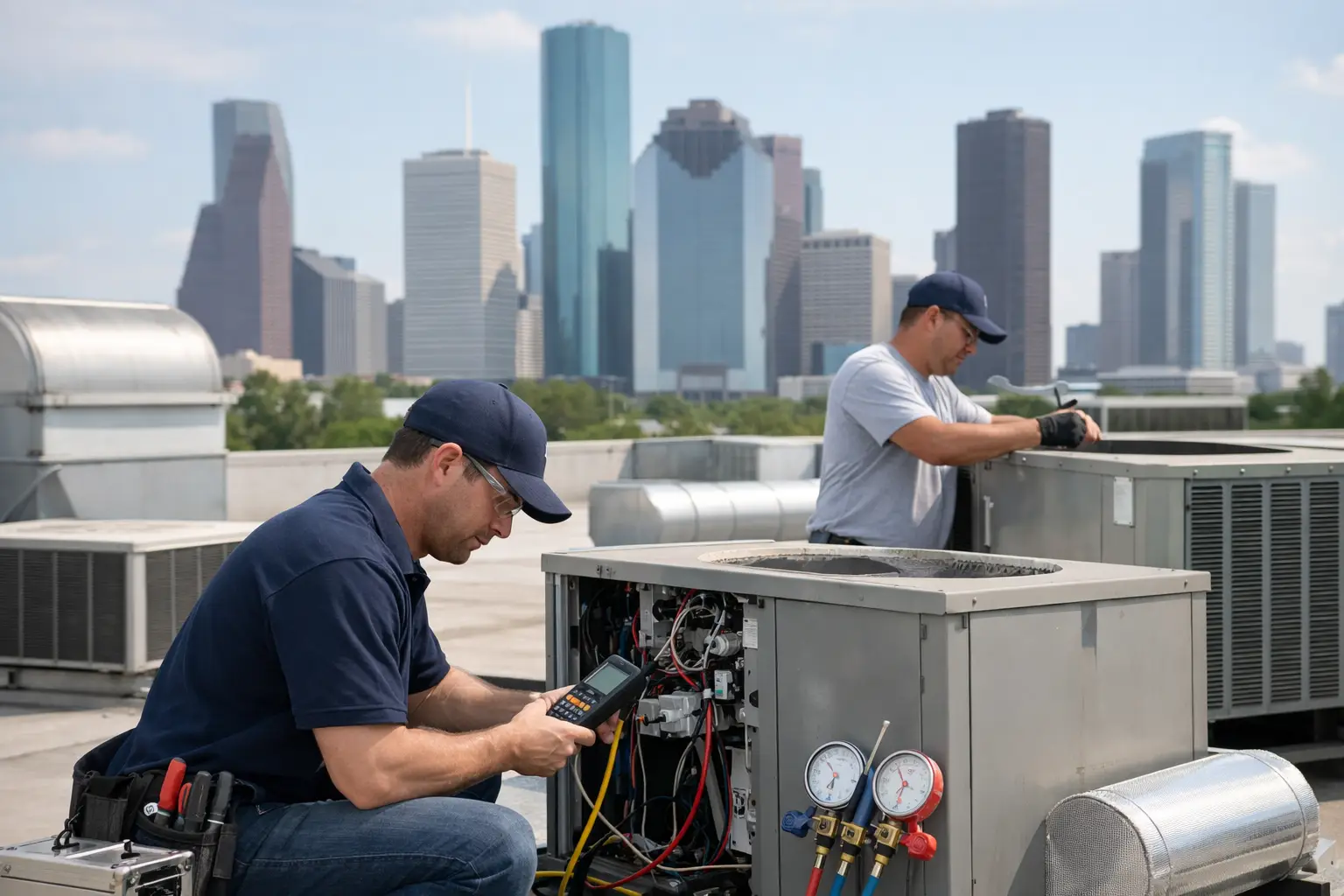
When a rooftop unit fails at 2 p.m. in July, the problem is not just temperature. It is lost productivity, unhappy tenants, distracted staff, and customers who may not come back. That is why choosing the right commercial HVAC contractor Houston area businesses rely on is less about finding the cheapest bid and more about finding a partner who can keep your building running under real-world pressure.
Commercial HVAC decisions carry more risk than most facility purchases. A poor repair can lead to repeat breakdowns. A rushed installation can create airflow problems that show up for years. An unclear service agreement can leave you guessing about response times when your system is already down. For business owners, property managers, and facility teams, the right contractor should reduce that uncertainty, not add to it.
What a commercial HVAC contractor in the Houston area should actually handle
Commercial work goes beyond basic heating and cooling calls. Office buildings, retail spaces, warehouses, churches, restaurants, and mixed-use properties all have different operating demands. The contractor you hire should be able to diagnose equipment problems accurately, repair packaged and split systems, service rooftop units, install replacement systems, and build a preventive maintenance plan that fits your schedule and budget.
That range matters because commercial HVAC is rarely a one-time need. You may call for an emergency repair today, but six months later you may need coil cleaning, thermostat upgrades, airflow balancing, or a full system replacement. Working with one qualified team creates continuity. They know your equipment history, your building layout, and the patterns that tend to lead to downtime.
If a contractor only seems strong in installations or only pushes replacements, that is worth noticing. Some problems call for repair. Some systems are costing too much to keep alive. A dependable contractor should be able to explain the difference clearly and back it up with findings from the jobsite.
Response time matters more in Houston than many owners expect
The Houston area puts HVAC systems under serious strain for much of the year. Long cooling seasons, high humidity, heavy occupancy, and rooftop exposure can shorten the margin for error. In many commercial settings, even a few hours without cooling can disrupt operations.
That is why response time should be part of your evaluation from the start. Ask how emergency calls are handled, whether after-hours service is available, and what a realistic arrival window looks like for your type of property. Fast response is not just a convenience. It can limit equipment damage, prevent indoor air quality issues, and help you avoid sending employees or tenants home.
Still, speed alone is not enough. A contractor who arrives quickly but diagnoses poorly can waste more time than a contractor who takes a little longer and fixes the issue correctly. The best service teams combine urgency with process. They show up prepared, communicate clearly, and explain what failed, what is needed now, and what may need attention next.
How to compare commercial HVAC contractors without getting stuck on price
Price matters. Every facility has a budget, and no one wants to overpay. But the lowest number on a quote does not always reflect the real cost of the job.
A lower bid may exclude items that later appear as change orders. It may rely on less efficient equipment, limited warranty support, or a smaller scope of work than your building actually needs. On the other hand, the highest quote is not automatically the most thorough. What matters is whether the proposal is clear, complete, and aligned with your operating goals.
When reviewing estimates, pay attention to how the contractor defines the work. Are labor, materials, controls, startup, and disposal included? Is there any discussion of load requirements, equipment sizing, or expected energy performance? Does the contractor explain whether repair is a short-term fix or a practical long-term option?
Good commercial proposals make decision-making easier. They do not hide behind vague language. They tell you what is being done, why it is being recommended, and what you should expect after the work is complete.
Signs you need more than a repair
Many business owners hold onto aging systems because replacement feels disruptive. That is understandable. Installation affects scheduling, capital planning, and day-to-day operations. But there is a point when repeated repairs stop being the economical choice.
If your system is breaking down regularly, struggling to keep set temperatures, creating hot and cold zones, or driving up utility bills, it may be time to evaluate replacement. The same is true if parts are becoming harder to source or if technicians are keeping the unit alive with one temporary fix after another.
That does not mean every older system needs to be replaced immediately. Some can continue performing well with proper maintenance and targeted repairs. The key is getting an honest assessment. A qualified commercial HVAC contractor Houston area property managers trust should be able to walk you through repair-versus-replacement tradeoffs without pressure.
Preventive maintenance is where the real savings usually show up
Emergency repair gets attention because it is urgent. Preventive maintenance often gets delayed because it is not. That is a mistake for most commercial properties.
Routine service helps catch worn belts, dirty coils, refrigerant issues, drainage problems, electrical concerns, and control faults before they become shutdowns. It also helps equipment operate more efficiently, which matters when cooling demand runs hard for months at a time.
For some buildings, quarterly maintenance makes sense. For others, twice a year may be enough. It depends on occupancy, equipment type, hours of operation, and how critical climate control is to your business. A lightly used office has different needs than a retail site with constant door traffic or a property with tenant comfort requirements.
A good maintenance agreement should feel specific, not generic. It should reflect your equipment and your risk level. If every property gets the exact same checklist and schedule, the contractor may be selling a plan rather than solving a problem.
What business owners and property managers should ask before hiring
Credentials matter, but so does communication. Licensed and insured service is the baseline. From there, you want to know how the contractor handles dispatch, diagnosis, approvals, documentation, and follow-up.
Ask who will perform the work and whether the team has experience with commercial systems like yours. Ask how findings are reported and whether recommendations are explained in plain language. Ask what happens if a repair does not hold or if replacement equipment has a long lead time.
You should also pay attention to how the company communicates before you ever sign anything. If it is difficult to get a clear answer, a detailed estimate, or a realistic timeline during the sales process, service after the job starts may not improve.
This is one reason many local businesses choose established providers with broad service capability. A company that handles diagnostics, repair, installations, rooftop units, maintenance, thermostats, and indoor air quality under one roof is often better positioned to support the full life cycle of your system. That practical, full-service approach is part of what businesses look for in providers such as BluePeak 360.
Why local knowledge makes a difference
Commercial HVAC is technical everywhere, but local conditions matter. In this region, humidity control, long cooling demand, storm impacts, and heat load swings are all part of the job. Buildings with frequent door openings, older duct systems, or sun-exposed rooftops can develop recurring issues that a contractor unfamiliar with the area may underestimate.
A local team also tends to understand how service expectations work here. Owners want straightforward pricing, quick scheduling, and technicians who respect the site and communicate with staff professionally. That sounds basic, but it is often the difference between a vendor you use once and a service partner you keep.
For multi-site owners and property managers, consistency matters just as much as technical skill. You need confidence that the same standards will apply whether the call is routine maintenance or an urgent failure.
The right contractor should make operations easier
The best commercial HVAC relationships are not built on one repair. They are built on reliability over time. Your contractor should help you reduce downtime, plan ahead for aging equipment, and make informed decisions about repairs, upgrades, and replacements.
That means clear communication, transparent pricing, and work that holds up after the truck leaves. It also means understanding that every building has constraints. Sometimes the best choice is a targeted repair to get through a season. Sometimes the smartest move is replacement before failures start affecting tenants or customers. A trustworthy contractor will tell you which situation you are in and why.
If you are evaluating providers, look for the company that treats your HVAC system like part of your business operations, not just another service call. When your heating and cooling are handled well, your people stay comfortable, your equipment lasts longer, and your day runs with fewer interruptions. That is the kind of support worth hiring before the next outage forces the decision.